Our story
The Mediterranean and South Atlantic coastal and marine areas present diverse participatory governance traditions and a wide range of economic activities. The wide range of stakeholders contributes to a variety of interests and conflicts that can generate additional controversies if not properly considered and managed in the development of management frameworks, such as ICZM (Integrate Coastal Zone Management) and MSP (Marine Spatial Planning), being considered as one of the main barriers for coastal resilience. With these challenges in mind, the project aims to ensure the integration of citizen input into the policy-making process through the testing of proven participatory tools, thus improving the prevention and resolution of conflicts, which have been considered key barriers to the implementation of climate change adaptation plans.
INCORE-MED was developed in response to the urgent need to address the impacts of climate change on Mediterranean and South Atlantic coastal areas. Inspired by social movements and the call for new models of environmental governance, the project brings together universities, regional governments, NGOs, and research centres to co-create lasting solutions in order to strengthen public participation, enhance legitimacy and promote inclusive democratic practices in the prevention of climate risks by using two different participatory methodologies in 4 different pilot sites, namely in Algarve, Catalonia, Sardinia and Kaštela.
Consortium
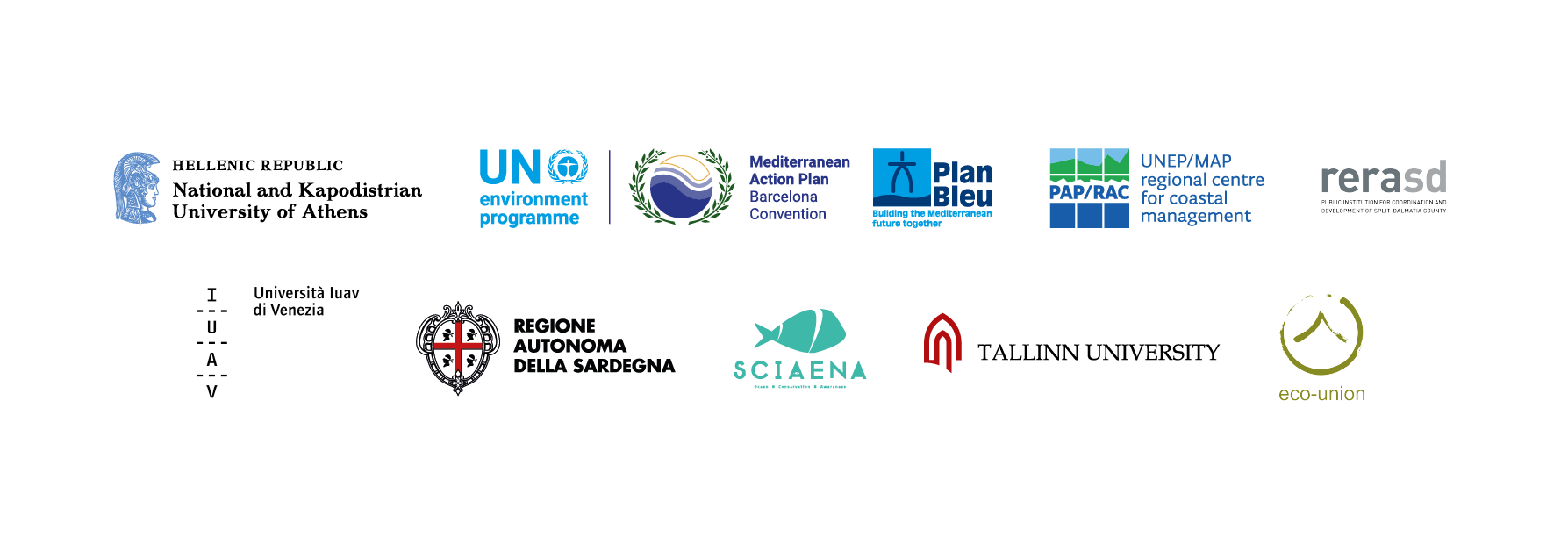
9 partners across 7 countries:
- National and Kapodistrian University of Athens – Ports Management and Shipping Department NEKUA (Greece) – Lead Partner;
- Plan Bleu (France);
- PAP/RAC (Croatia);
- PI. RERA S.D. (Croatia);
- IUAV – University of Venice (Italy);
- Sardinia Region (Italy);
- Sciaena (Portugal);
- Tallinn University (Estonia);
- eco-union (Spain).
With the support of associate partners such as AMAL, CCDR-Algarve, Generalitat de Catalunya, AVITEM, and SMILO.